Friday, May 17, 2013

Intermarket Secular Shifts and the Great Rotation Trade: Long US Stocks, Short Treasuries

http://www.thebullbear.com/profiles/blogs/great-rotation-secular-shift

In the introduction to the last Bull Bear Market Report, I further developed the thesis that an impulsive equities bull market began in November 2012:
Most analysts continue to make the mistake of believing that a secular bull market started in March of 2009. The actual situation of this market very closely parallels the 1974-1982 time frame. While the price bottom was made in 1974, the actual secular bull did not begin until the 1982 low. Our contemporary 2009 bottom and November 2012 low are playing the same role and function. While a great many market participants believe that this bull is "long in the tooth" and fret that the market is at or near the prior all time highs, a correct understanding of the actual context of the current market setup shows that instead we are yet in the early stages of a secular bull. It's also important to note that while skepticism regarding the market rally is not as negative as it was in 2010 and 2011, it is roughly comparable to the period of the 1982 breakout. Now as then, optimism is growing with a lingering backdrop of deep skepticism and fear. The general investing public is still largely ensconced on the safety of bonds or in cash.
Even as the US markets continue to hit fresh all time highs on a nearly daily basis, many commentators and analysts feel that the market is "high" and are fearful of buying. The misconception that the bull market started in 2009 has set up a fierce bull run that is currently targeting the 1695-1700 area on the SPX futures by early June and approximately 1760 by early August.
Today we saw an upside channel break. We have seen this develop into a fractal pattern. The first upside channel break came in January as SPX busted through the parallel channel bounded by the 2010 and 2011 lows and the 2011 and 2012 highs (that contained the (E) wave sideways triangle bear wave). The second upside channel break came in March as the upper rail of the rising wedge formation bounded by the March and September 2012 highs and the June and November 2012 lows was busted. The third upside channel buster came today as the market accelerated through the upper boundary of the bullish impulsive parallel channel formed since the November 2012 bottom. This is extremely bullish tape action particularly in light of the rest of the technicals underlying this market as well as an extremely unique intermarket setup. Barring a rapid reversal back into and through the bull channel, the coming weeks should see undignified chasing as investors attempt to pile into a stock market which has refused to give them an entry point. It should also see a decline in US Treasuries that shocks most market participants.
While early 2013 saw much anticipatory chatter about "The Great Rotation" out of Treasuries and bonds in general and into equities, a recent review of the financial media shows that that chatter has been replaced by disinterest and skepticism. Even as the rotation has started to accelerate and even as charts and technical indicators are showing clear setups for a downdraft in bonds, few recognize that it is actually happening.
A Google search for "Great Rotation" finds mostly skeptical views:

On April 29 I told BullBear Traders that it was time to short Treasuries:
April 29, 2013 at 4:00pm

SHORT TREASURIES
I bought a small position in TMV, the 3X Treasuries Bear ETF. TLT:SPY ratio appears set for a large breakdown:
tlt-spy ratio
At the same time the stock market appears set for a 3 of 3 bull run to new all time highs.
spx futures
My take is that the "Great Rotation" trade is probably about to start for real very soon.

Two weeks later Treasuries appear poised to break down from a Head and Shoulders top and have declined continuously without a pause. Tape action has been very bearish. Yet Bond funds are still attracting record flows and PIMCO's bond holdings are now at multi year highs:
treasury bond google search
At the same time, incongruously with his market exposure, Bill Gross has (yet again) called the top in the bond market. My take is that the third time will be the charm for Bill, though he apparently lacks the courage of his own convictions (twice bitten, thrice shy apparently): "Mr. Gross stressed in his comments Friday that a bear market in bonds, typically defined as a price decline of 20%, isn't imminent." I don't think it's difficult to see that a decline to 120-127 in the 30 Year has already begun and though I don't yet have a sense of how long it will take it will not surprise me to see that zone hit before the end of 2013.
In the April 24th BullBear Market Report, I also indicated a long term bullish setup for the US Dollar:
The very long term chart of US Dollar argues strongly for a period of long term strength:
us dollar index
Compare the 1987-1996 period and the 2008-2013 period. I think we are about to see a lengthy period of US Dollar outperformance as investment capital flows into Dollar denominated assets. The precious metals bear market crash is likely an early response to this effect.
Note that this comes at a time when market psychology presumes the "Death of the Dollar" as imminent and inevitable and that it comes in the wake of QE Unlimited. Dollar bears and precious metals bulls have been handed the ultimate, favorable conditions and yet the anticipated result has not occurred. "When a market does not do what it should do when it should do it then it is about to do THE EXACT OPPOSITE in a very big way".
It's not fashionable to talk about a resurgent US economy and renewed US global competitiveness. "Everyone knows" that can't happen. Yet when "everyone knows" something, often the opposite turns out to be the case. My take is that the technicals of the Dollar, Bonds and US stock market are indicating that "everyone" is about to learn something about dangers entrenched assumptions and attempting to overlay political worldview over market trading.
Indeed, we are seeing the Dollar Index in the early stages of breaking out from a inverse Head and Shoulders bottoming pattern formed over the period from 2004-present.
This piece of market commentary starts to recognize that intermarket relationships are undergoing a secular shift:
It's an unusual combination: Rising stock market, rising Treasury yields and a firming dollar.


Here's my snapshot view of the current intermarket setup:
  • impulsive, secular bull market breaking to new all time highs in stocks
  • breakdown from a long term Head and Shoulders top in the 30 Year Treasury Bond
  • breakout from a nearly decade long inverse Head and Shoulders bottom in the US Dollar
This setup iis probably sending the signal that significant US centric economic growth is on the horizon.
 
The now two year long bear market in commodities and the recent plunge in metals prices is likely an early response to a coming period of persistent dollar strength. In the recent BBMR I indicated that I expect crude oil to join the bearish trend in commodities soon:
CRUDE OIL
Remember "peak oil"? It was broadly "known" that crude oil production had begun a secular decline that could not be arrested. The only possible result: disaster. Mass starvation, war and a reversion to pre-Industrial Revolution living standards. But something happened on the road to the Apocalypse. The world's largest economy appears on track to become a net oil exporter within 10 years. And the chart seems to be forecasting a C wave decline to something like $45.00.
crude oil futures
Note that a drop in WTIC prices to $45 would be an incredible cost savings boon to domestic operations of US companies and the economy in general. The savings generated by the halving of energy costs would be a major catalyst for real GDP growth. And that's what this chart appears to be forecasting.

I think it's probably got a few more weeks of churning before it really starts to break down, but I established a small position in the crude oil bearish ETF DNO today.

The overall intermarket environment appears to be in the process of a major, secular shift that correlates well with the technical shift from primary bear to primary bull that took place in the stock market during 2012.

My targets are:
SPX Futures 1695 by June and 1760 by September
30 Year Treasury Bond 120-127
US Dollar Index 106
Crude Oil $45.00
I am long SSO, long TMV and long DNO.
 
The rest of this report details the technical characteristics of the secular shifts in SPX, Treasuries (and the rest of the bond market), the US Dollar and Crude Oil. 
 

Need some help staying on the right side of the markets? Join the BullBear Traders room at TheBullBear.com. You'll get this kind of timely, incisive, unbiased stock and financial market trading, timing, forecasting and investment technical analysis and commentary daily. It's free to join, no credit card is required and if you like my work you just make a donation at the end of each month.
Keeping You on the Right Side of the Market
PLEASE CONSIDER MAKING A DONATION TO SUPPORT MY WORK USING THE PAYPAL LINK BELOW.
THANK YOU!

Tuesday, April 30, 2013

Long Term Bullish

Long Term Bullish

In the March 10 BullBear Market Report, I concluded that the US equities markets had ended the long term bear market that started in 2000 with the November 2012 low and had begun a new, secular bull market:
This report comes down on the side of concluding that indeed a new, secular Bull Market has begun. While there is still some chance that a bear market (D) wave top could come in the vicinity of the 2007 highs, evidence is mounting that the 2011-2012 period was an (E) wave of a long term triangle and that recent price breakouts and changes to the technical character of the market mark the start of a very long term Major (V) bull market. The Dow Jones Industrial Average appears to be projecting to a completion of the ongoing bull market from the 1932 low in the area of 18,800 in the late 2015-early 2016 time frame.
If a market has transitioned into a new phase, then indicators should be expected to behave differently. We are already seeing that many technical conditions which had previously been solid markers of a top are no longer. One of the mistakes that analysts are likely to make in the coming months is that they will be relying on bear market methodologies to trade bull market conditions. We are going to need to look for new setups to trade this bull effectively.
In the April 3rd BullBear Market Report, I called for the continuation of an intermediate term correction of the move off the November low:
My current analysis is that the S&P 500 has reached an intermediate term top in the context of the early stages of a impulsive bull market wave. The latest technical development supporting the bull market thesis is that we have seen the completion of a rather clear Elliott Wave 5 sequence bullish impulsive wave with subwaves that also show bullish impulsive structures and characteristics. On March 15th the market began a Wave 2 correction of the Wave 1 that started in November 2012. This corrective wave could be expected to last an additional 3-6 weeks and should retrace about 38.2% of Wave 1.
Three weeks later, it appears likely that the intermediate term correction may be over. SPX has apparently corrected in a sideways triangle within a bullish parallel channel. The correction did not approach the minimum 23.6% retracement generally associated with an intermediate term correction and did not break horizontal or channel support (at least not yet, anyway). The wave corrected just 14% of the prior move at its maximum depth. There has been a decent correction of technical indicators, however, on the daily and weekly time frames, such that the market is no longer overextended.
In the March report, I warned that technical setups that had worked for intermediate term trading during the bear market may no longer be applicable:
If a market has transitioned into a new phase, then indicators should be expected to behave differently. We are already seeing that many technical conditions which had previously been solid markers of a top are no longer. One of the mistakes that analysts are likely to make in the coming months is that they will be relying on bear market methodologies to trade bull market conditions. We are going to need to look for new setups to trade this bull effectively. Fortunately, if we are in an impulsive bullish environment, longer hold times will be possible and fewer trades will be necessary.
Indeed, the technical setup we saw beginning with the March 15 top was identical to that which had pertained to the 2010, 2011 and 2012 tops, yet in this case we did not see the same intermediate term price correction but rather a minor correction within the trend. This sets up the potential for a breakout above the 2007 highs after a 5 week consolidation and if this happens it would come in a powerful Wave 3 position in the context of an extended Wave (1). That means a large, strong, persistent bull move may be on the calendar in the near term.
Tape action has been bullish, particularly of late. Support levels have been bought persistently, particularly the 50 Day EMA. Bad news and heavy selling in stocks such as GE and IBM have not impacted the broad market or even their respective sectors. The market is treating each stock on its own merits. That's bullish tape action as it shows selective behavior by investors. At the same time, we are seeing some significant long term breakouts. Microsoft and the Semiconductor sector come to mind. There have been very few "pop and drop" earnings news reversals, a sign that investors are not looking for the exits on good news and that stock is held by strong hands. Recently we have seen markets in the US, China and Europe rally strongly on bad economic news when they were potentially positioned to break down. Altogether, we have seen market behavior that tends to correlate well with the long term bull market thesis.
The hope was that we might sell longs and even take a short position during the intermediate term correction with an eye towards putting on a larger long position at the bottom. That was a quite reasonable scenario under the circumstances that existed at that time. The fact that the market has refused to allow that is another very bullish indication.
We cannot yet entirely dismiss an intermediate term correction from these levels.  Certainly if we get a dismal GDP report on Friday morning that could be enough to spark a round of heavy selling and a break of support.  But even so, at this time I would regard the decline as a buying opportunity.  There is little  technical evidence to support a Major (D) wave top at this time.  It would take a steep decline followed by a B wave rally to a marginal new high with associate long term technical divergences to set up a new cyclical (E) wave bear market.
Most analysts continue to make the mistake of believing that a secular bull market started in March of 2009. The actual situation of this market very closely parallels the 1974-1982 time frame. While the price bottom was made in 1974, the actual secular bull did not begin until the 1982 low. Our contemporary 2009 bottom and November 2012 low are playing the same role and function. While a great many market participants believe that this bull is "long in the tooth" and fret that the market is at or near the prior all time highs, a correct understanding of the actual context of the current market setup shows that instead we are yet in the early stages of a secular bull.  It's also important to note that while skepticism regarding the market rally is not as negative as it was in 2010 and 2011, it is roughly comparable to the period of the 1982 breakout.  Now as then, optimism is growing with a lingering backdrop of deep skepticism and fear.  The general investing public is still largely ensconced on the safety of bonds or in cash.
As a technical analyst I am free of the burden of needing to understand why the market is doing what it is doing. I am strictly concerned with what it is doing, what it is setting up to do and what it is likely to do. Having said that, it is helpful sometimes to reflect on the underlying fundamental forces driving a market along. There appear to be two primary characterizations of the fundamental environment. The first regards the rising stock market as an inflationary epiphenomenon of massive global monetary liquidity. The second anticipates significant, dynamic economic growth nationally and globally that will eventually become evident and will explain and justify rising stock valuations.
The two year bear market in commodities and the recent plunge in metals prices would seem to contradict the inflationary market hypothesis. If inflation were the motive force here, it should effect all asset classes. That gold, the ultimate inflation hedge, has been in a bear market during most of the Quantitative Easing experiment would seem to refute inflation as a primary driver of the stock market bull.
There are not yet any clear signs of the emergence of new, dynamic growth sectors in the US economy and internationally signs of slowing in the Chinese growth engine. If the market arrives at a technical top in the 2015-2016 time frame without any real, organic underlying economic growth, then it will be likely set up for the grand super cycle debt bubble pop that so many doomer economists and analysts have been calling for.
My current view is that clearly monetary inflation is playing some role in generating the conditions for the stocks bull market. It is making bonds an unappealing option, it is keeping the financial system flush with liquidity and it provides an underlying psychological confidence to investors. But I don't buy the notion that we will get a valid secular bull market on monetary inflation alone. There will have to be some degree of real world economic growth involved. One area that may be playing a big factor is the US energy boom. New technologies are making very large oil deposits accessible that were previously economically unavailable. As the economy becomes more energy efficient through new green technologies, the US may become energy independent and a net exporter of crude by 2020. As supply grows and demand stabilizes, the price of crude oil may fall significantly for a long period of time. In fact the chart is showing signs of following the rest of the commodities complex into a large bear market decline. An economy wide decline in energy costs could be an enormous boon to the US, setting up a resurgence of global competitiveness. Another key factor is technology and innovation. For example, the 3D Printing revolution could have profound and dynamic effects on the relationships between products, consumers and manufacturing. Radical new materials also offer the potential for dramatic developments in economies of scale, energy efficiencies, production and distribution. It's also important to keep in mind that US corporations are currently very lean and efficient and sitting on record cash piles that if invested under the right circumstances could propel a real economic boom. And much like the 1995-2000 period, the US dollar may rise on the strength of demand for dollar denominated assets as the world once again makes the USA the preferred investment haven. In fact the dollar is showing signs of a long term bottom very analogous to the bottom made in the 1995 period.
Keynesian monetarism has distorted and retarded national and global economic growth. If market forces had been allowed to prevail for the last 40 years, many of the economic, social and technological hurdles we are now seeking to clear would have been long ago surmounted. Fiat debt money creates malinvestment, distorts financial systems, skews wealth distribution, corrupts political systems, creates a dependent, undereducated labor force and fosters the worst in human character. To the extent that we have needed extreme measures to exit the problems of 2007-2008, those who have taken such measures are to blame for creating the circumstances that required them. It's going to be infuriating to anyone who advocates economic freedom and sound money, but I think we are bound to see the Keynesian Monetarists gloat that they have proven the integrity of their "model" for the next few years. And then? Will the chickens produced by the so many debt eggs laid over so many years finally come home to roost? I think there is a technical case for that top of all tops in the 2015-2016 period. And if the right technical circumstances come together against a backdrop of an inflated market without any real underlying dynamic growth, then the gold bugs and doomer economists may finally have their day to gloat. But as they say, "Be careful what you wish for...because you just might get it."
The long term weekly chart of Equal Weighted SPX has broken to and sustained a new all time high well ahead of the capitalization weighted SPX:

Similarly, Wilshire 5000, Wilshire 4500, Equal Weighted Nasdaq 100, Midcaps, Smallcaps and Transports have all held well above the prior all time highs, leading SPX higher:

If an (E) wave bear market were on the table, we would not be seeing such outperformance; instead we would be seeing the opposite.

Need some help staying on the right side of the markets?  Join the BullBear Traders room at TheBullBear.com.  You'll get this kind of timely, incisive, unbiased stock and financial market trading, timing, forecasting and investment technical analysis and commentary daily.  It's free to join, no credit card is required and if you like my work you just make a donation at the end of each month.

Keeping You on the Right Side of the Market

PLEASE CONSIDER MAKING A DONATION TO SUPPORT MY WORK USING THE PAYPAL LINK BELOW.    THANK YOU!
  Make a One Time Donation

Wednesday, April 3, 2013

Time for a Bull Market Correction


Time for a Bull Market Correction
The last BullBear Market Report concluded that:
a new, secular Bull Market began in November 2012. While there is still some chance that a bear market (D) wave top could come in the vicinity of the 2007 highs, evidence is mounting that the 2011-2012 period was a stealth (E) wave ending a long term triangle and that recent price breakouts and changes to the technical character of the market mark the start of a very long term Major (V) bull market...

My current analysis is that the S&P 500 has reached an intermediate term top in the context of the early stages of a impulsive bull market wave. The latest technical development supporting the bull market thesis is that we have seen the completion of a rather clear Elliott Wave 5 sequence bullish impulsive wave with subwaves that also show bullish impulsive structures and characteristics. On March 15th the market began a Wave 2 correction of the Wave 1 that started in November 2012. This corrective wave could be expected to last an additional 3-6 weeks and should retrace about 38.2% of Wave 1. The market recently completed a B wave rally that carried slightly beyond the March 15th high resulting in a host of bearish technical setups that provided an excellent exit opportunity for long side trades and even a nice shorting entry for more active swing traders. The current C wave down will probably complete a larger degree A wave with another B wave rally likely (possibly back to the recent high) followed by a larger C wave decline. The subsequent C of 2 bottom should be one of the best long term entry points in a bull market that projects to late 2015-early 2016.
While it's too soon to discard the possibility that SPX has completed a (D) wave cyclical bull market and will now enter into the final (E) wave leg of the long term triangle bear market, I do not think that the technical setup supports that at this point. The technical conditions attendant at the 2000 and 2007 tops are not present at the moment. It is possible perhaps that after this current decline the market rallies to a higher level (1600-1620) making a B wave high with the kinds of bearish technical divergences on the weekly and monthly charts that could mark a long term wave (D) top.
technical analysis of S&P 500
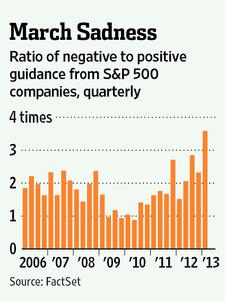
It's interesting to note that when the market was setup technically for a correction the news catalysts necessary to spark the move appeared out of nowhere. On March 15th it was the onset of the Cyrpus crisis and today it was a spate of negative economic news. In the wake of the weak ADP report today there's considerable risk that the jobs picture may show further erosion in the Challenger and Jobless Claims reports on Thursday and the Employment Report on Friday. Earnings season starts very soon and warnings from S&P 500 companies have been surging.


Additionally, it is likely that Cyprus bailout story is not yet fully written and that there are other shoes yet to soon drop in the ongoing European debt bubble saga. Overall I expect the period of this correction to generate slightly more fear and volatility than the April 2012 correction but not as much as the April 2010 episode. I'm comfortably short at the moment and looking forward to a good long term buying opportunity that should be good for a holding period of a year or more.


Need some help staying on the right side of the markets? Join the BullBear Traders room at TheBullBear.com. You'll get this kind of timely, incisive, unbiased stock and financial market trading, timing, forecasting and investment technical analysis and commentary daily. It's free to join, no credit card is required and if you like my work you just make a donation at the end of each month.
bullbear trading
Keeping You on the Right Side of the Market
PLEASE CONSIDER MAKING A DONATION TO SUPPORT MY WORK USING THE PAYPAL LINK BELOW. THANK YOU!
Make a One Time Donation